Evaluation of Various Sensing Modalities for Accurate Measurement of Neck Flexion Angle during Thyroid and Ear Surgery
Last updated: 2020/02/23 21:53
Summary
Our project aims to accurately measure the neck flexion angle of surgeons during thyroid and ear surgery using two IMUs
Background
There is more and more evidence nowadays suggesting that specific posture of surgeon while operating can contribute to cervical musculoskeletal strain, discomfort, and chronic pain. The persistent neck flexion, long periods of static posture and the long time use of microscopes and magnifiers lead the microsurgeons in a particularly high risk to the pain mentioned above.
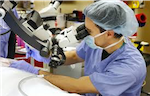
The above figures from left to right are figure 1 (from https://oklahoman.com/gallery/articleid/3808606/),
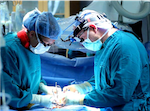
figure 2 (from http://amandeepmedicity.org/specialities/bariatric-metabolic-surgery),
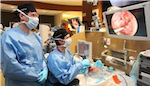
and figure 3 (from http://www.tristonekidneyhospital.com/index.html).
In this project, we are focusing on the surgeon posture during two surgery: Thyroid and Ear surgery. As for both ear surgery and thyroid surgery, there are two kinds of cases: traditional case and endoscopic case. When the surgeons do ear surgery in a traditional way, as shown in figure 1, they have to look through microscopes. For thyroid surgery in a traditional way, as shown in figure 2, surgeons have to stand over the patient. It's obvious that the surgeons have to band their necks,sometimes they even need to band over their bodies in order to finish specific operations. However, as for endoscopic cases, as shown in figure 3, surgeons can make full use of the monitors, it’s easier for them to keep their head and body in a line for most of the time.
Significance
Poor surgical ergonomics may lead surgeon disability.
A recent survey of plastic surgeons in the United States, Canada, and Norway showed that nearly two-third of respondents reported neck discomfort related to their occupation[1].
Among surveyed laparoscopic, ophthalmic, and general surgeons, the reported prevalence of musculoskeletal symptoms in the neck and shoulders is as high as 87%[2]
The neck flexion angle data may help showing the advantages of endoscopic surgery.
The angle data can also be used to correct the new surgeons’posture, preventing them from chronic injury.
Deliverables
Minimum:
Calibration result of two IMUs separately against EM tracker (Linear regression function)
Documentation of software setting and calibration steps (doc file)
Expected:
Data analysis report of mock OR surgery data
Maximum:
Data analysis report of all possible surgeries
Final report
Technical Approach
We will use two IMUs (Inertial measurement unit) to do neck flexion angle measurements. One will be banded in front of surgeon’s head, and the other will be stabilized in front of surgeon’s chest. The pitch angle we measured is the `\theta` shown in figure 4.
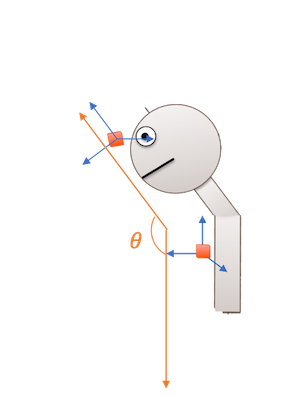
Figure 4
The whole project will be done following the workflow shown below.
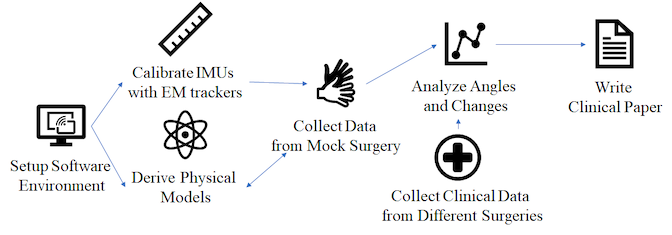
Step 1: Set up EM tracker and IMUs software in Linux and ROS system.
Step 2: Calibrate every IMU’s angle in one direction by the ground truth derived from EM trackers.
Step 3: Derive the mathematical model of pitch angle from 6 sensors data ( including two 3-axis gyroscopes, two 3-axis accelerometers, and two 3-axis magnetometers).
Step 4: Collect data from once mock surgery and analyze it to ensure Step 2, Step 3, and data collection process are correct.
Step 5: Collect clinical data from 20 different surgeries for 8 different scenarios.
Step 6: Analyze all clinical data to find interesting things, like the largest neck flexion angle, the angle last for a long time, difference between traditional case and endoscopic case, and difference between young residents and surgeons with expertise.
Step 7: Write a clinical paper.
Dependencies
Timelines
Milestones and Status
Reports and presentations
Project Plan
Project Background Reading
Galen Robot Group Weekly Meeting
Project Checkpoint
Paper Seminar Presentations
Documentations
Project Final Presentation
Project Final Report
Project Bibliography
Yan, Xuzhong, et al. “Wearable IMU-based real-time motion warning system for construction workers' musculoskeletal disorders prevention.” Automation in Construction 74 (2017): 2-11.
Versteyhe, Mark, et al. “A Novel Method to Estimate the Full Knee Joint Kinematics Using Low Cost IMU Sensors for Easy to Implement Low Cost Diagnostics.” Sensors 20.6 (2020): 1683.
-
Naresh-Babu, J et al. “Surgeon's Neck Posture during Spine Surgeries: “The Unrecognised Potential Occupational Hazard”.” Indian journal of orthopaedics vol. 53,6 (2019): 758-762. doi:10.4103/ortho.IJOrtho_677_18
Lobo D, Anuarbe P, López-Higuera JM, Viera J, Castillo N, Megía R. Estimation of surgeons' ergonomic dynamics with a structured light system during endoscopic surgery. Int Forum Allergy Rhinol. 2019;9(8):857–864. doi:10.1002/alr.22353
Other Resources and Project Files
Here give list of other project files (e.g., source code) associated with the project. If these are online give a link to an appropriate external repository or to uploaded media files under this name space (456-2020-08).